KIRILL & FRIENDS BERLIN FESTIVAL
KIRILL & FRIENDS BERLIN FESTIVAL
WHAT?
- Theater
- Film Program
- Exhibitions
- Artistic Workshops
- Talks
- Parties
WHEN?
4–13 September 2026
WHO?
KIRILL & FRIENDS is a theater company founded in Berlin in 2023 by the theater and film director Kirill Serebrennikov.
It is a community of artists from different countries, cultures, and artistic backgrounds.
WHY?
For us, art is not about buildings or institutions. It is about people. It is the possibility of looking into another person's eyes, hearing another voice, and sharing time, space, and experience.
Over the past three years, the projects of KIRILL & FRIENDS have been presented in Hamburg, Düsseldorf, Duisburg, Salzburg, and Paris. Now, for the first time, we’re bringing them together in one city—Berlin.
For ten days, KIRILL & FRIENDS BERLIN FESTIVAL is transforming Berlin into a living cultural ecosystem—a place where new encounters, new ideas, and new creative collaborations begin.
Because "Friends" is not a closed circle. It's an open invitation. Everyone who shares our curiosity, our belief in artistic freedom, and our desire to create together is welcome to become part of our community.
WHERE?
Komische Oper Berlin / Schillertheater
Bismarckstraße 110, 10625 Berlin
Deutsches Theater Berlin
Schumannstraße 13A, 10117 Berlin
DOCK 11 / DOCK ART
Kastanienallee 79, 10435 Berlin
DOCK 11 / EDEN
Breite Straße 43, 13187 Berlin
CUBIX am Alexanderplatz
Rathausstraße 1, 10178 Berlin
St. Matthäus-Kirche
Matthäikirchplatz, 10785 Berlin
ALL TOGETHER
KIRILL & FRIENDS BERLIN FESTIVAL
The first festival by KIRILL & FRIENDS.
Note: All productions within the festival contain nudity. We therefore recommend a minimum age of 16 for attendance.
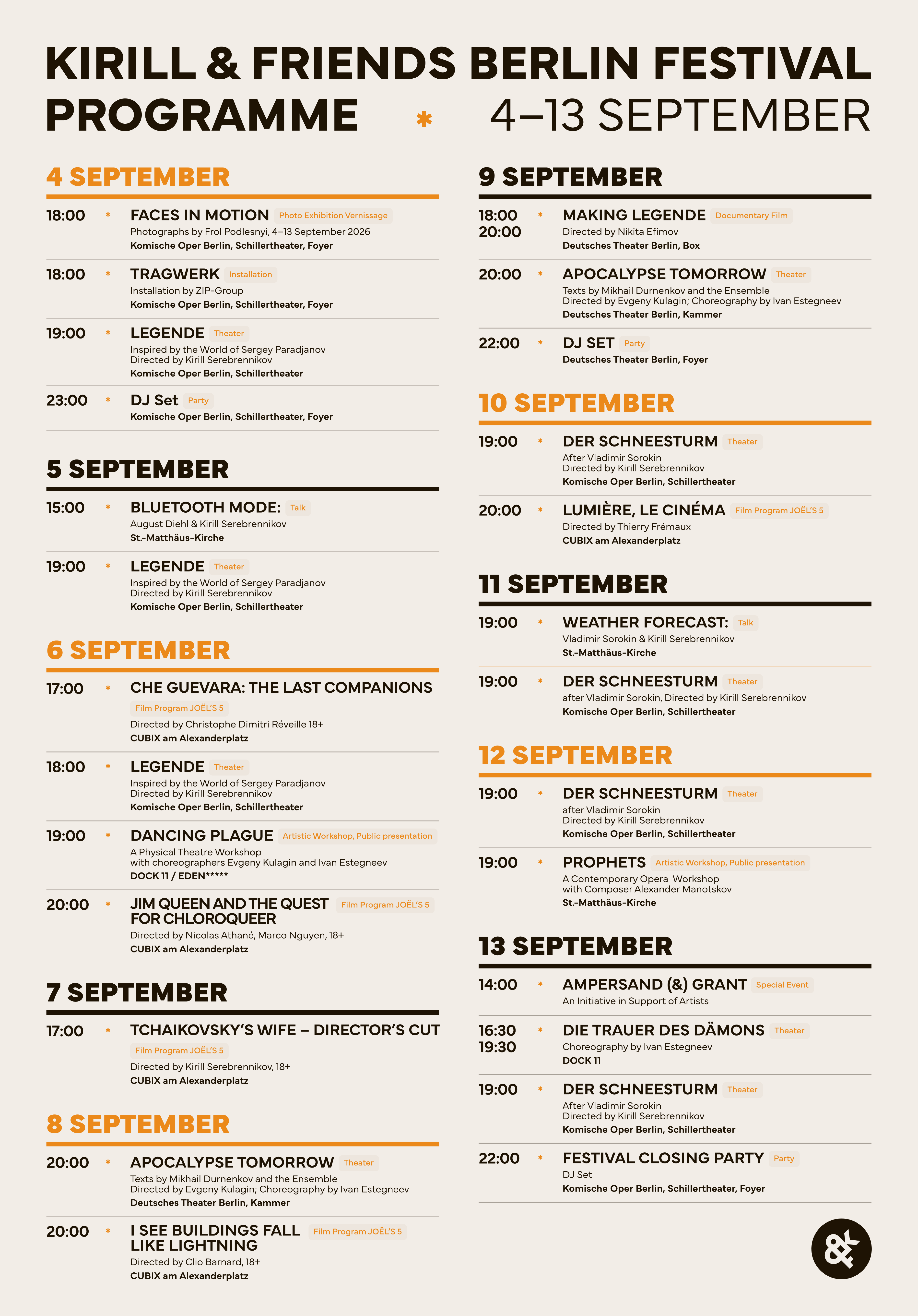
September 6–10
CUBIX am Alexanderplatz
For more than thirty years, Joël Chapron has worked with the Cannes Film Festival as a Foreign Correspondent. A film critic, festival expert and selector, he has spent many years working with international film festivals and closely following developments in world cinema.
For the Kirill & Friends Berlin Festival, he has curated a selection of five films spanning different genres, from animation and documentary cinema to historical drama and socially engaged storytelling. Four of them were presented in various sections of the Cannes Film Festival and became highlights of their respective editions. The fifth film, Lumière! Le Cinéma by Thierry Frémaux, General Delegate of the Cannes Film Festival and Director of the Institut Lumière, is a special tribute to the origins of cinema and to the art of film itself.
Together, these films form a program that reflects Joël Chapron's personal view of contemporary cinema and at the same time serves as his declaration of love for the movies.
DREAMS OF CINEMA
In the 130 years since cinema came into being, directors have pushed technical boundaries to the point of embracing artificial intelligence—before it replaces them. It seemed right to me to return to the roots of this art of the moving image, to see how it has served—and continues to serve—the artistic vision of each filmmaker, how documentary and feature filmmaking interact, and how live-action and animated images respond to one another.
The Lumière brothers invented it all, and yet everything remained to be done. While it is often said that everything has already been said, written and filmed, it is nevertheless clear that every filmmaker's perspective on the same subject matter is different. Admittedly, stories abound, but one filmmaker's camera will focus on aspects of a story that another will overlook. It is this unique perspective that each filmmaker possesses which constitutes their strength, originality, and talent.
From the 130 short films that make up Lumière, Le Cinéma by Thierry Frémaux to Jim Queen by Marco Nguyen and Nicolas Athané—what a long way we've come! And yet both films depict the society into which they were born. In Clio Barnard's I See Buildings Fall Like Lightning, the protagonists struggle through their daily lives as they come to terms with the abandonment of the dreams they once cherished, while the characters in Christophe Dimitri Réveille's Che Guevara: The Last Companions recount the struggle they waged to see their dreams come to fruition. As for Kirill Serebrennikov's Tchaikovsky's Wife, its heroine burns her wings trying to reach the unattainable star of her husband.
Enjoy the dreams!
The Kirill & Friends Berlin Festival not only offers performances and encounters with artists, but also creates a space for experimentation, research, and the development of new artistic forms.
In the summer of 2026, an open call was announced for two festival workshops: one dedicated to movement and the other to contemporary music. We received numerous applications, after which the workshop leaders selected the participants for their programs.
Over several days, participants, musicians, students, and people from a wide range of backgrounds will work together with members of the Kirill & Friends artistic team, exploring new possibilities in theater, music, and performance. Intensive rehearsals, collective exploration, and real-time creation will form the foundation of these laboratories.
The result of each workshop will be a public presentation—fast, raw, and inevitably imperfect. Not a finished performance, but the moment an idea comes into being. Not a final product, but a process. Quick and dirty. Here and now.
I. OPEN CALL
A Contemporary Music Workshop with composer Alexander Manotskov
10, 11, 12 September 2026 | Full-day workshop, Berlin
Kirill & Friends Berlin Festival invites actors, musicians, performers, and anyone interested in exploring the intersection of voice and contemporary music theatre to take part in PROPHETS, an artistic workshop led by composer Alexander Manotskov.
Working languages: English and German.
Applications were accepted until 7th August 2026.
II. OPEN CALL
Artistic Workshop: Physical Theatre Lab with choreographers Evgeny Kulagin and Ivan Estegneev
4, 5 & 6 September 2026 | Full-day workshop, Berlin
Kirill & Friends Berlin Festival invites dancers, performers, physical theatre actors, circus artists, movement practitioners, and anyone interested in exploring the expressive potential of the body to take part in DANCING PLAGUE, an artistic workshop led by choreographers Evgeny Kulagin and Ivan Estegneev.
We are looking for participants who are open to intensive practice, improvisation, and collaborative artistic research. Previous professional experience is welcome, but above all we are looking for curiosity, commitment, and a willingness to experiment.
The workshop will conclude with a public presentation of DANCING PLAGUE as part of the Kirill & Friends Berlin Festival.
Working languages: English
Applications were accepted until 7th August 2026.
September 4–13
Komische Oper Berlin / Schillertheater
Foyer
FACES IN MOTION
Photographs by Frol Podlesnyi
But perhaps it is the other way around: relationships between people are what create a place.
Once I found myself far from familiar surroundings, I was constantly on the move. Once city quickly gave way to another, and over time I noticed something strange: the places themselves gradually faded from memory, while the people I associated with them remained.
I had noticed before how I could not perceive a city separately from the people in it. This does not make the city any less important—quite the opposite. But only now have I begun to understand how profoundly another person can change the way we experience a place.
Most often, the person I was photographing chose where we would meet. Sometimes we would go somewhere neither of us had been before. In those cases, the photograph captured not only the person but also our first shared experience of that place.
Perhaps when we lose our familiar points of reference, we begin to understand more clearly what truly matters to us. We are used to associating a sense of belonging with a place. But perhaps it comes from relationships—from the connections that allow an unfamiliar space to become our own.
That is why, in these photographs, the city rarely appears as a complete image. What matters to me is not preserving it in its entirety, but holding on to the connection between a person and a place.
that I intend to continue.
Frol Podlesnyi
Curator: Ekaterina Podlesnaia
Design: Kit Hell
Lighting Design: Daniil Moskovich
Fine Art Printing: Tilo Müller
Interns: Telma Duhau, Polina Radkova, Ksenia Weber
Produced by Kirill & Friends Company
Special Thanks: Xenia Torska, Sasha Kuznetsova, Maria Pudalova, Ekaterina Shulepova, Alexandra Friese, Entenwerder1 (Hamburg)
September 4–12
Komische Oper Berlin / Schillertheater Foyer
TRAGWERK
An Installation by ZIP Group
ZIP Group is an independent contemporary art collective founded in Krasnodar, Russia, and now based in Berlin. After being forced to leave in 2022, the artists continued their work in Germany, focusing on community, migration, urban space, and collective forms of cultural life.
Created specifically for the Kirill & Friends Berlin Festival, TRAGWERK is a site-specific installation made of vertical wooden beams connected into a single self-supporting structure. The work reflects on solidarity, mutual support, and community.
Small sculptures attached to the beams refer to monuments across Berlin—among them Schiller, Marx and Engels, the Soviet soldier in Treptower Park, and Bismarck. The installation is conceived as an open space: visitors can walk through it, sit within it, meet, and spend time together.
Integrated into TRAGWERK is Safety Theater, an installation by Ksenia Sorokina and Aleksandr Plotnikovdedicated to the production Finist, the Bright Falcon and to Russian theater artists Zhenia Berkovich and Svetlana Petriychuk, imprisoned in Russia in connection with their artistic work.
ZIP Group about TRAGWERK
“We were inspired by the space itself—the stained-glass window in the main foyer, the light, and the scale of the room.
For us, the simple form of the vertical beam carries many associations: it can evoke a human figure, a column, a match, or a candle.
The small sculptures attached to the beams grew out of our walks around Berlin. We chose familiar monuments, made them deliberately rough, and changed their scale. We were interested in how monumental figures become small objects, while the structure itself turns into a kind of pedestal for them.
We invite visitors to recognize these figures and to think about what becomes visible in the space around us—and what remains unseen.”
This project is a collaboration between ASoP Europe (BMEIA) and Kirill & Friends Company.
Komische Oper Berlin / Schillertheater Foyer
SECURITY THEATER
An Installation by Ksenia Sorokina and Aleksandr Plotnikov
Artist: Ksenia Sorokina
Curator and Concept Creator: Aleksandr Plotnikov
Security Theater is an installation dedicated to the production Finist, the Bright Falcon (Moscow, 2020).
Ksenia Sorokina about SECURITY THEATER
“My friends and colleagues on this production, director Zhenia Berkovich and playwright Svetlana Petriychuk, were sentenced in July 2024 to six years in prison on charges of ‘justifying terrorism’. I was the set and costume designer of the production.
On the advice of a lawyer, I left Moscow three days after their arrest and have never returned home.
This exhibition tells our story and the story of the production. It is a handmade archive reconstructing the events we lived through between 2021 and 2024.
We created a play about women in prison, about women who became victims of terrorism within their families and of state violence. Now that two of the creators of the production are themselves in prison, the play has crossed over into our own lives, and the boundary between artistic fiction and real-life absurdity has completely dissolved.
‘Security theater’ describes highly visible security measures that create the impression of greater protection while doing little to increase actual safety. Procedures intended to reassure the public and create a sense of security instead leave us—both artists and spectators—with feelings of rage and powerlessness.
We believe that archiving and reflecting on these feelings is an important task for the present moment.”
Concept & Curation – Kirill Serebrennikov
Head of Production – Alina Aleshchenko
Dramaturg – Anna Shalashova
Technical Director – Siarhei Rylko
Artistic Production Team:
Junior Producers – Ruven Bircks, Fedya Larionov
Theater – Ekaterina Kostiukova
Film – Denis Korneevsky
Exhibition – Ekaterina Podlesnaia
Interns – Telma Duhau, Polina Radkova, Anna Sharko
Press & Marketing
Press and Public Relations – k3 berlin
Marketing – Maria Lupandina
Website – Gregory Sazankov
Photographers – Maksim Avdeev, Frol Podlesnyi
Videographers – Frol Podlesnyi, Sergey Korsakov
SMM – Kseniia Apresian
Poster by: Petr Bankov
Design by: Natasha Shendrik, Kit Hell
Front of House:
Gregory Sazankov (Head), Kseniia Ignatova, Siegfried Margin
Heads of Department (Theater Program):
Technical Director – Siarhei Rylko, Aleksey Poluboyarinov
Head of Stage – Alex Reit
Lighting – Sergey Kuchar, Daniil Moskovich
Sound – Sven Baumelt, Viacheslav Kasianov
Video – Ilya Shagalov
Costumes – Elizaweta Veprinskaja
Props – Julia Chaplygina
Make-Up – Baina Uchaeva
FESTIVAL PARTNERS





SPECIAL THANKS

MEDIA PARTNERS